
With the official release of One Step at a Time less than two weeks away (mark your calendar for November 18!), I wanted to share a sample chapter from the book. It offers a glimpse of my writing and storytelling—and hopefully gets you excited to read more!
So without further ado, I hope you enjoy it.
Chapter 14
THE GRAYSON HIGHLANDS
Day 38
AT Miles: 480.2–499.9
State: Virginia
Grayson Highlands State Park, tucked in the southwestern corner of Virginia, spans over 4,800 acres within the Jefferson National Forest. Visitors from around the world, including AT hikers, come to experience its rugged peaks, grassy meadows, and lush forests. Located about 30 miles north of Damascus, the park takes its name from its home in Grayson County, one of Virginia’s original counties. Adjacent to Mount Rogers—Virginia’s tallest peak—the Grayson Highlands offer breathtaking views, but the biggest draw is the wild ponies that roam free throughout.
Introduced in the 1970s, these grazing ponies help prevent grasses from overtaking the balds, allowing other plant life and wildlife to thrive. Today, there are more than 100 ponies living in the park. Distinct in appearance, the ponies are small, with short legs and thick, shaggy coats. Their long manes and tails flow in the breeze. They come in shades of brown, black, gray, and white. Several herds roam the park, each led by a stallion protecting the mares and foals. The mares are especially protective of their young. Although typically gentle towards humans, hikers are advised to keep a safe distance. Still, many can’t resist offering a cute pony a snack or a back scratch, so the ponies have become accustomed to humans.
Longhorn cattle also roam the area and graze beside their pony companions. As the name implies, their horns are long and curved, growing up to six feet. Despite their intimidating appearance and muscular build, they’re gentle by nature. Ranchers round them up each winter and move them to lower elevations. The ponies, however, tough it out through the snow. Most survive by foraging, but an especially harsh winter can take a toll on the herd.
The Wilburn Ridge Pony Association, a nonprofit, helps manage and preserve the pony population. Each fall, members round up as many ponies as possible for veterinary checks. As part of an agreement with the state park, they also gather some foals to sell at an annual auction, which helps keep the herd size sustainable. Ponies can sell for several hundred dollars—sometimes over $1,000—and the proceeds support ongoing herd care.
As Pam and I trek through Grayson Highlands, we walk as the trail takes a bend. I jump at the sight of a four-legged creature standing in the trees.
“Pony!” I yell.
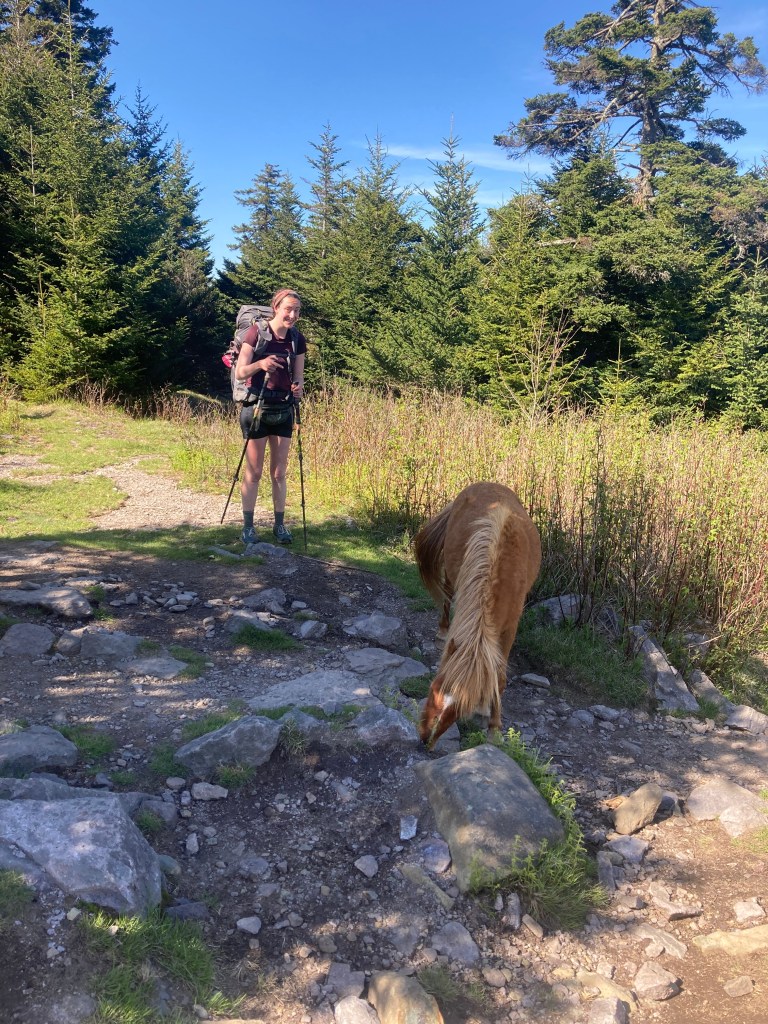
About ten feet off the trail, Pam and I see our first pony. It has a white coat and a flowing blonde mane. It is smaller than I imagined—its back barely the height of my hip.
We keep climbing as the trail gains elevation toward Mount Rogers. At a trail junction for the summit, we spot another pony standing right next to the sign. This one is solid brown with a dark blonde mane.
“Should we try to get a picture with it?” Pam asks.
“I don’t know,” I say, a little uneasy. “We can try.”
Pam and I grew up in a city. Neither of us knows much about livestock. I’m uncomfortable approaching large animals—even if it’s a small pony. I walk slowly toward it, keeping a respectful distance.
“Just don’t stand behind it,” Pam warns. “That’s when they kick ya.”
I freeze about 10 feet to the pony’s side and pose for the camera.
“Say cheeeeese!” Pam hollers, then snaps the photo.
We swap places.
“Say Seabiscuit!” I joke, snapping her picture.
We laugh at our cheesy photos and continue down the trail, which bends sharply into dense brush. Further up, we hear fast-moving hooves. Pam and I stop in our tracks. Through the thicket, we see two ponies galloping toward us—one brown, one all white—barreling down the trail in our direction.
Thinking that they might run into us, Pam yelps, and we both leap off the trail onto a narrow, brushy herd path. Ten yards ahead, the white pony veers off trail where a cluster of trees blocks its way. The brown pony overtakes it, slams to a stop on its front hooves, then delivers a powerful back kick straight into the white pony’s side. The white pony lets out a loud neigh. Pam and I gasp.
Without breaking stride, and riding its momentum, the brown pony turns onto the same herd path as Pam and me.
“It’s coming this way!” I yell.
“Oh no. Oh no. Oh no,” Pam cries from behind me.
We have no time to scramble farther back. We brace ourselves. The brown pony stops directly in front of us—its snout close enough to touch. We hold still, unsure what will happen next. It blows air from its nostrils but doesn’t move any closer or show any more aggression.
“Let’s back away,” I whisper.
We slowly step backward, still facing the animal. Branches snap beneath our feet. Once back on the trail, we march ahead, glancing over our shoulders at the ponies, now standing apart and still. After a bend in the trail, we pause to catch our breath.
“That was a close one,” Pam says.
“You’re darn tootin.”
Just then, we hear another crack in the woods. We flinch and turn. Behind a few trees stands a small foal. It has the same brown color as the pony we just saw kicking.
“It must have been protecting this little one,” I say.
“You’re probably right,” Pam replies. “But I don’t trust these ponies anymore.”
“How did your thru-hike end?” I say sarcastically. “I got kicked by a pony.”
What began as a magical encounter now comes with a sense of caution. Our guard is up. Still, the view of surrounding mountains—bathed in a bluish tint—soon distracts us. We are, after all, hiking along the shoulder of Virginia’s highest peak.
It’s not long before we reach Thomas Knob Shelter. It’s a double-decker perched at a sweeping viewpoint.
“You don’t want to stay here tonight?” I ask, knowing Pam has already picked a campsite another mile away.
“You don’t want to keep going? The next campsite has great views.”
“Well,” I say. “Honestly, I’m worried about tenting with these ponies.”
“Come on now. You’ve always said you want to be a cowboy.”
“You mean I’m not already?”
“Not unless you camp like one.”
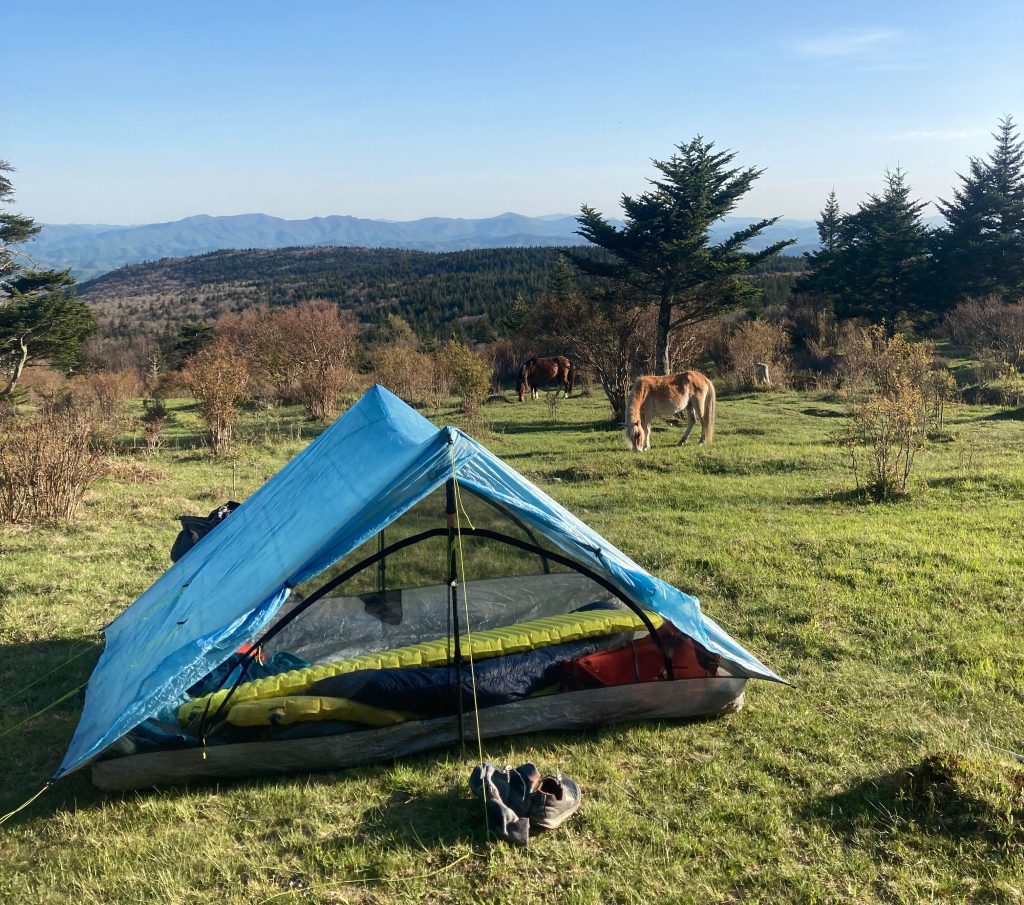
We continue another mile to a spot appropriately named Many Campsites—a grassy area where other hikers have already set up for the night. We walk around, searching for a flat patch to call home. On a distant hillside, ponies graze—and cattle too. Some of the cows have massive, long horns.
“What kind of cow is that?” Pam points.
“A Longhorn, maybe? I don’t really know.”
We pause to watch a black Longhorn with white horns chomp lazily on grass.
“I’ve never felt more like a city slicker,” I say.
“Come on, cowboy. Let’s find a spot.”
We settle on a slightly sloped spot with a view of the wide-open valley. A few regular old cows graze in the nearby grass. They are easily four times bigger than the ponies. The thought of being trampled by a cow in the middle of the night crosses my mind. The chances of being killed by a cow are low—but never zero. Still, the view makes it feel like a risk worth taking. The cows, for now, keep their distance.
We drop our backpacks. Pam and I get started on our usual camp tasks without any discussion. After a month on trail, the division of labor has become automatic. I set up the tent and sleeping pads while Pam walks to a nearby stream to collect water and start dinner.
As I pull out gear, I keep an eye on the cows. The herd is growing. More cattle wander up the hill and spread out across the field. There are now twenty cows grazing this few-acre patch, and some are getting closer to where I’ve pitched our tent.
“Cows,” I mutter to myself. “Why does it have to be cows?”
When Pam returns from the stream, three cows are within thirty feet of our tent. One is very close—just ten feet away.
“Where did these guys come from?” Pam asks.
“They are coming out of the woodwork,” I say, watching them nervously.
“Did you tell them to go away?”
“I don’t speak cow, Pamela.”
Pam steps toward the closest one. It’s big and all black. The cow lifts its head, noticing Pam inching closer.
“Go away, cow! Go on, get!”
I watch with amusement as I blow air into a sleeping pad. The cow stares back blankly, then lowers its head and rips up another patch of grass with its teeth.
“Hey, you, cow!” Pam continues. “You gotta go, cow!”
“This town ain’t big enough for the three of us, cow,” I say, in a country accent.
Pam shoots me a look. “You’re gonna sleep outside tonight.”
Pam gives up and sits down to filter water. The cow eventually wanders off in search of greener grass, but two others remain close. Pam moves on to cooking dinner. While waiting for water to boil, she opens packets of Ramen noodles—our dinner of champions. That’s when another figure catches my eye.
“Incoming,” I warn from inside the tent.
Another cow approaches Pam’s makeshift kitchen. But as it gets closer, it becomes clear—this one isn’t just a cow. It’s a bull. And not just any bull. This one has the most enormous testicles I’ve ever seen—each roughly the size of a cantaloupe, swinging between its hind legs like a pair of wrecking balls.
“Holy cojones,” I say. “This guy is packing.”
“Huh?” Pam asks.
“His balls! They’re huge!”
“Why are you looking at his balls?” Pam yelps as it steps closer. “What am I gonna do? Come help me!”
“Hold your ground!” I say.
The big white bull stops just a yard from her. Pam holds her ground next to the stove and food, while the bull hovers, hoping she’ll offer up a snack.
“Go away, cow! Please, go away,” Pam pleads. “Kev, please come out here and help move the food.”
I crawl out of the tent and get to my feet. As I do, the bull steps a few paces away.
“He’s going,” I say, hopeful.
But he’s not going. He has merely turned to defecate—only feet away from Pam.
“Aww shit,” I say.
“Oh. My. God.” Pam steps backward.
The feces fall out of the cow’s ass and plop in large clumps on the grass. The bull tops his freshly laid pie with a steady flow of piss.
“That’s just disrespectful,” I say.
Only after discharging all it can, the bull walks off, a pile of shit laying five yards from our tent.
“Help me get the food away from the cow shit,” Pam says.
“Yes, dear.”
I grab pots. Pam grabs the stove and noodle packets. We move to an area free of cow shit and piss. As we cook, we keep our heads on a swivel, on the lookout for anymore invading livestock.
Pam finishes cooking, and we scarf down dinner as quickly as possible. The cows begin to graze farther off. But just as peace seems restored, another wave arrives.
“Here come the ponies,” I note, slurping on a noodle.
Like the cattle before them, ponies of all shapes and colors graze their way up the hill. One wanders toward a campsite fifty yards away, where a hiker has left their tent unzipped to use the outhouse. The pony sniffs around, then sticks its head through the open door and begins rustling through their gear.
“Should we do something?” Pam asks.
I shrug, too tired to intervene.
The pony pulls its head out with a bright red apple clenched between its teeth.
 Kevin Ravas